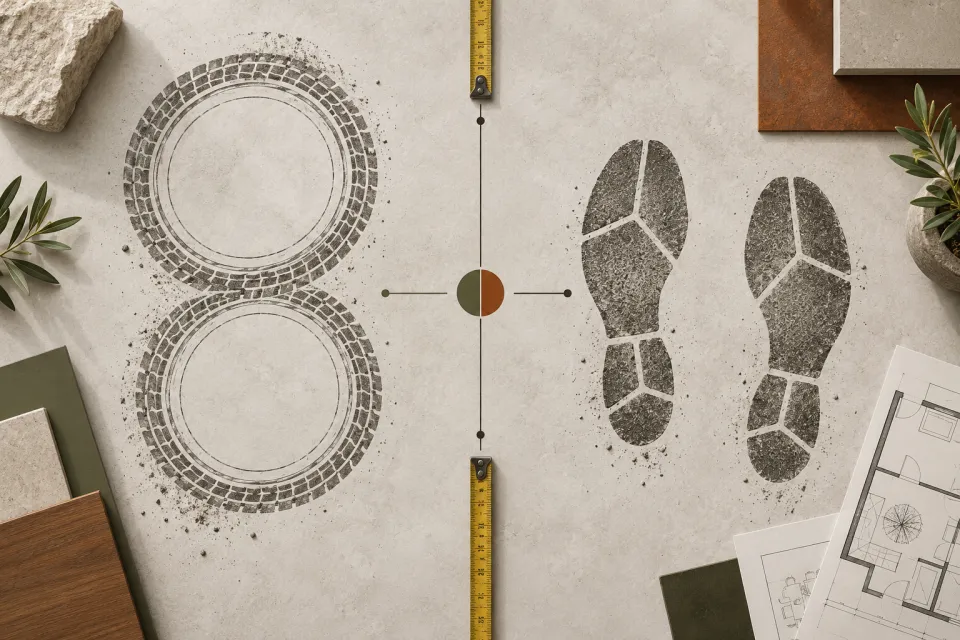
Compare the pictured forms against the route and task
Current official Homebot One imagery depicts KOKO on a floor-moving base rather than on two legs. “Pictured mobile-base form” is a visual description, not a published engineering specification: the reviewed pages do not state wheel count, drive layout, dimensions, speed, traction limits, or stair capability.
A floor-moving base and a bipedal form address movement differently, and neither is automatically better for a home. Compare the exact rooms and task path that matter, using version-specific documentation and an approved demonstration instead of extrapolating from the silhouette.
Map the surfaces and transitions in the real environment
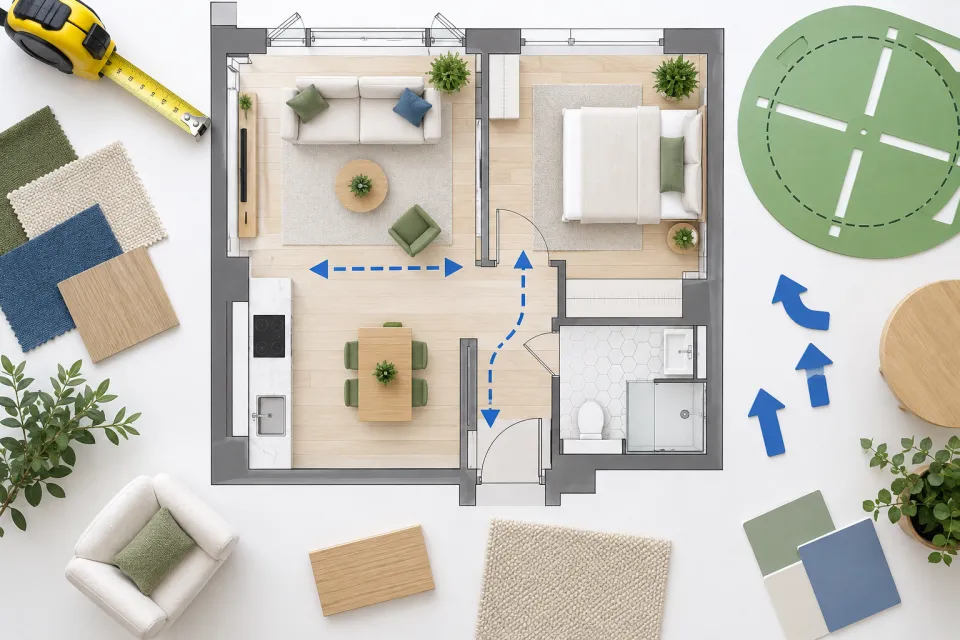
Draw the intended route from the approved home position to the task area. Mark floor types, thresholds, narrow turns, mats, cables, doors, furniture pinch points, drop-offs, and any place people or pets commonly cross. Have the Homebot One team identify which of those conditions are within the current evaluation scope and which should be excluded.
Run only an approved, supervised route test. Record the starting position, direction of travel, stopping behavior, assistance, and any reset. Do not extrapolate from a smooth demonstration floor to a different home. If a transition is unverified, treat it as a boundary until the manufacturer supplies guidance or demonstrates it safely.
- Measure the narrowest route and turning area rather than relying on a photograph.
- List every surface change and ask which have been evaluated with the evaluation unit.
- Identify drop-offs and restricted zones before movement begins.
- Keep an accessible stop control and a clear human recovery plan.
Compare reach and positioning separately from mobility
Reaching a room and interacting with something in that room are separate capabilities. The base may arrive at a location while the relevant control, surface, or object remains outside the supported interaction area. Ask what position the evaluation unit needs, what it can interact with, and which setup changes or human steps are required.
Use the same task definition for any bipedal comparison. Specify the target position, object or interface, acceptable contact, time window, and recovery behavior. Otherwise, one robot may be credited for entering a room while another is judged on completing a much more demanding physical sequence.
Ask how stability, stopping, and recovery are handled
Movement comparisons should include normal stopping, an interrupted route, a blocked path, loss of a dependency, and the procedure after the system cannot continue. Ask how the evaluation unit communicates its state and what the operator should do. Do not improvise lifting, towing, pushing, or manual repositioning; those actions require current manufacturer instructions.
A bipedal system may present balance and fall-recovery questions. A mobile-base system may present clearance, traction, threshold, or entrapment questions. These are categories of questions, not claims about a particular product. Evaluate only the conditions and procedures documented for the exact hardware in front of you.
- How does the operator issue a normal pause or stop?
- What state is shown when the route is blocked or localization is uncertain?
- Who may reposition the system, and what written procedure applies?
- Which surfaces, slopes, transitions, and restricted areas are outside the supported test?
Score the form against a defined household outcome
Create a scorecard for one outcome: route coverage, setup effort, interaction position, supervision, recovery, noise, storage, and effects on other people in the space. Give credit only for what you observe or what current documentation supports. Leave unknowns visible rather than assigning a favorable score from the robot’s general shape.
The result may differ by home and task. A continuous single-level route can pose different questions from a multi-level route, and a research platform can be judged by different criteria from a household pilot. Choose the form whose documented current behavior best fits the stated environment, while retaining a human alternative whenever the task is important.
Frequently asked questions
Does a mobile base mean KOKO can travel on every household floor?
No. Have the Homebot One team identify which surfaces and transitions have been evaluated for the evaluation unit, then test only an approved route under the specified conditions.
Is a bipedal home robot automatically better at stairs?
No. Body form does not establish stair capability or safety. Any stair use requires product-specific evidence, operating limits, and procedures.
What should I measure before a KOKO route evaluation?
Measure narrow passages, turns, thresholds, clear floor area, and the target interaction position. Mark restricted zones, drop-offs, cables, and common traffic paths.
Can I move KOKO manually between rooms or floors?
Treat manual lifting or repositioning as unsupported until Homebot One provides the handling procedure, required number of people, and any conditions that make movement inappropriate.
Sources & further reading
From Homebot One, the team building KOKO in Fremont, California.