Privacy belongs in the value calculation
A home robot can be evaluated by more than its purchase price or list of features. It may operate in rooms where people relax, work, talk, and receive visitors, so the way it handles household information can change whether the product feels useful at all. The price is right only when the controls, responsibilities, and practical benefits fit the people sharing the space. A lower-cost option with unclear data terms may carry more uncertainty than a better-documented option.
Homebot One describes KOKO as a home robot in development and the KOKO Home page presents a vision built around real-time spatial memory. That public description is a useful starting point, but it is not a complete data inventory or privacy policy. A buyer should separate the product vision from the written answers needed for a decision: what information is created, where it is processed, who can access it, how long it remains available, and what happens when an account or service ends.
Build a data map before comparing offers
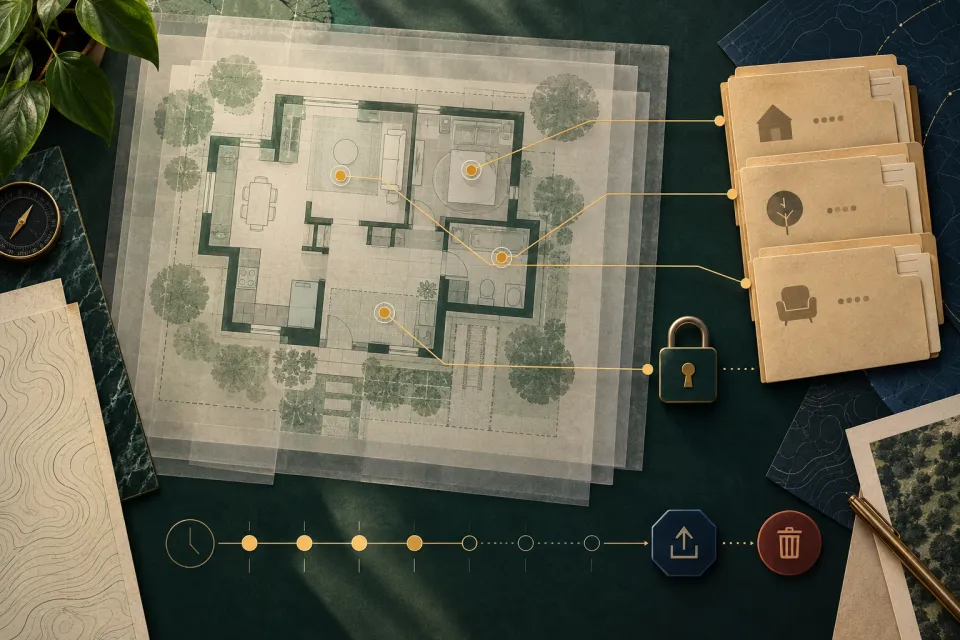
Ask the vendor to describe data by category and purpose rather than relying on a broad word such as “memory.” A useful map distinguishes account information, device diagnostics, room or object representations, audio or images, interaction history, and information supplied by integrations. For every category, record whether collection is required, optional, or disabled by default. Do not assume that a feature description proves a particular sensor is always active or that a specific data type leaves the home.
Then trace each category through its lifecycle. Note where processing occurs, whether information is transmitted, which service providers receive it, how retention is set, and which household members can view or remove it. Guests and children may not have created the account, yet they can still share the environment. The worksheet should therefore include notice, consent, pause controls, visible status cues, and a practical way to handle a guest who does not want to participate.
- Data category and the specific feature that needs it.
- Local, cloud, or mixed processing, confirmed in writing.
- Default retention period and any household-controlled setting.
- Roles allowed to view, export, correct, or delete information.
- Procedure for visitors, shared accounts, and account transfer.
Identify the controls that create real value
A privacy control has value when an ordinary household can find it, understand it, and use it without breaking the product. Useful questions include whether a person can pause sensing, disable an optional feature, review recent activity, remove an individual record, export important information, and delete an account. Also ask what continues to work after a cloud service is unavailable. These are evaluation questions, not claims about KOKO’s current implementation.
Documentation and support matter as much as buttons in an app. NIST’s consumer IoT profile highlights product documentation, secure updates, vulnerability reporting, data protection, and the expected support period. Those obligations can affect long-term value because unclear support creates work for the household. Ask who receives a privacy question, how quickly material policy changes are communicated, and whether older hardware receives the same controls as a newer configuration.
Translate privacy choices into cost scenarios
Do not assign a dollar value to privacy by guesswork. Instead, build scenarios that show how a data decision changes cost or usefulness. If a desired function requires an ongoing service, place that service in the recurring-cost column and record the cancellation consequence. If exporting records would be necessary before switching products, include the household time needed to organize and move them. If a feature must be disabled to meet a family rule, calculate value using the remaining functions rather than the advertised maximum.
A simple comparison can use three cases: preferred controls, acceptable controls, and unacceptable controls. For each case, list the functions available, recurring obligations, household administration time, and unresolved questions. The method prevents a false bargain. It also gives Homebot One or another vendor a clear opportunity to answer the exact issue rather than responding to a vague request for “better privacy.”
- Preferred: the requested control is documented and the useful workflow remains available.
- Acceptable: a limitation exists, but the household has a workable mitigation.
- Unacceptable: the household cannot meet its consent, retention, or deletion rule.
- Unknown: treat the item as an open decision risk, not as a confirmed benefit.
Make the decision from written answers
Before a demo or quote review, choose five privacy questions that could change the purchase decision and send them in advance. During the demonstration, ask to see the relevant control rather than accepting a verbal description alone. Record the software version, account role, and test condition. A successful demo is evidence for that observed workflow, not proof that every data practice is settled for every future release.
Finish with a one-page decision record: confirmed controls, unacceptable conditions, remaining questions, owner for each follow-up, and the date the information was checked. Link the record to the quoted configuration and any service terms. This approach makes privacy part of the value case without inventing fear or certainty. It also creates a clean basis for revisiting the decision if the product, policy, household, or price changes.
Frequently asked questions
Does Homebot One publish a complete KOKO data inventory?
The official pages describe the product vision, including spatial memory, but the public material reviewed for this guide is not a complete inventory of data types, processing locations, retention periods, or account controls. Request current written documentation for the configuration you are evaluating.
Does a lower KOKO price automatically mean better value?
No. Compare useful functions together with recurring services, household administration, support duration, privacy controls, and switching costs. An unresolved requirement should remain an open risk rather than being counted as a benefit.
Can buyers assume KOKO works fully offline?
No. The official pages do not provide enough detail to assume a particular offline mode. Ask which functions require an account, internet connection, cloud processing, or subscription, and verify the answer in the relevant demonstration.
What is the fastest privacy test during a demo?
Choose one decision-critical workflow, such as pausing an optional function, reviewing recent activity, or deleting a record. Ask the team to demonstrate the control and explain what happens to linked copies or backups.
Sources & further reading
From Homebot One, the team building KOKO in Fremont, California.