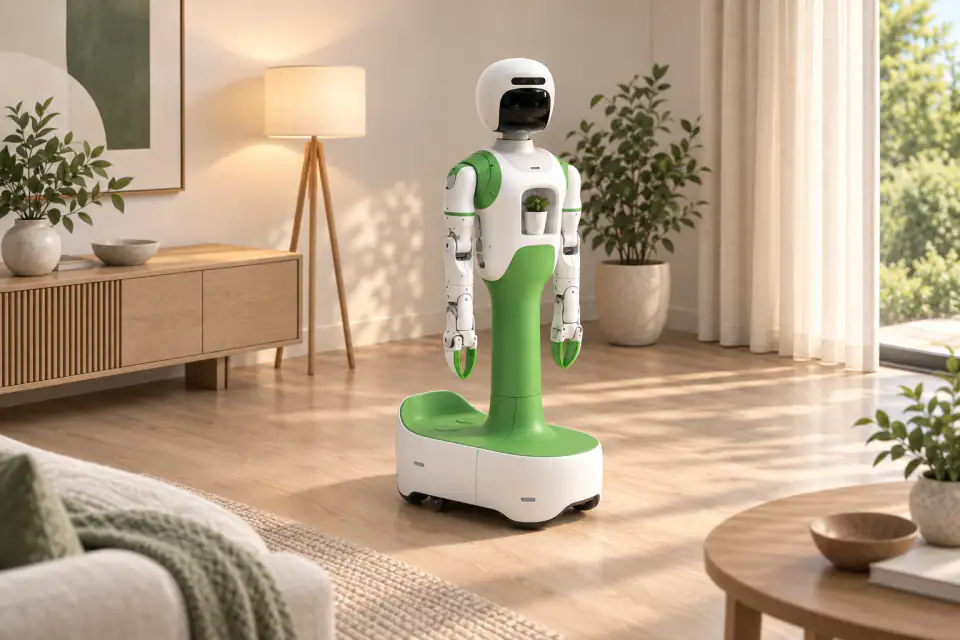
Service robot is a category, not a feature list
The International Federation of Robotics uses service-robot terminology for robots that perform useful tasks for people or equipment outside industrial automation applications. KOKO is publicly presented by Homebot One as a home robot, so service robotics can be a useful field for comparison. A formal classification for a program-specific KOKO version should still come from applicable documentation and the organization making that determination.
Calling something a service robot does not state which service it performs, how independently it operates, or whether it is available for purchase. Those questions require task-level evidence. Ask what the program-specific KOKO version can demonstrate, in which setting, with which controls, and how much preparation or human help is involved.
Classify the use context before the technology
Begin with the intended context: a household routine, an independent-living evaluation, a research study, or a developer project. Homebot One presents Home, Care, Research, and Developer entry points, but those labels do not establish identical hardware, access, support, or capabilities. Ask which program applies to your request and what is included now.
Then define one useful outcome in observable terms. A phrase such as help at home is too broad for classification or evaluation. A bounded outcome names the user, environment, starting condition, expected result, time, allowed assistance, and fallback. This makes it possible to compare KOKO with a fixed device, software service, another robot, or the existing human process.
- Setting: home, care-related pilot, research environment, or developer workspace.
- Task: one observable result with a clear beginning and end.
- Operator: the person who starts, supervises, pauses, and recovers the system.
- Access model: demo, pilot, research access, development access, or another confirmed arrangement.
Autonomy is a spectrum inside a task
A service robot can automate some steps while a person remains responsible for setup, approval, supervision, exception handling, or physical completion. Ask for a step-by-step account of the current workflow. Mark which steps are automatic, remotely assisted, manually controlled, or completed by someone else. Do not translate partial autonomy in one task into broad independence across the home.
The most informative moment may be when the task cannot continue. Ask how KOKO indicates uncertainty or a blocked route, what the user sees, how a stop works, and who restores the system. Calm, understandable failure handling can matter more to a household evaluation than an ambitious category label.
Do not treat classification as a safety or performance certificate
Service robot is a category, not a guarantee that a product is appropriate for every user or environment. Suitability depends on the exact build, task, room, controls, instructions, support, and people present. A standards-related claim should identify the standard, scope, version, assessor, and current documentation; do not infer certification from the general category.
For any evaluation, follow Homebot One’s current operating instructions and keep high-consequence duties outside the test unless an appropriate documented program explicitly covers them. Medication, emergency response, childcare, security, and unsupervised care should not be assigned on the basis of a service-robot label or a general demonstration.
- Ask which written instructions apply to the exact KOKO build.
- Confirm who is responsible for supervision and stopping the activity.
- Request evidence for each material claim about performance or compliance.
- Keep an established human process in place for important outcomes.
Use the label to find better questions
Service-robot resources can help structure questions about task design, human interaction, maintenance, reliability, privacy, and lifecycle support. Use those questions to inspect the current KOKO program rather than importing answers from a different robot. Two service robots can have entirely different forms, operating limits, data practices, and access models.
A concise description might be: Homebot One is developing KOKO as a physical home robot, and this evaluation examines one defined household task with stated human supervision. That sentence identifies the project and purpose without overstating its classification or capability. Add the build, date, and evidence as they become available.
Frequently asked questions
Is KOKO a service robot?
KOKO is presented by Homebot One as a physical home robot, and service robotics is a relevant broad field. A formal classification for a particular build or program should rely on current Homebot One documentation and the applicable definition.
Does service robot mean KOKO works autonomously?
No. The label does not specify autonomy. Ask which task steps are automatic, supervised, remotely assisted, or manual in the program-specific KOKO version.
Does the service-robot label prove KOKO is safe for every home?
No. A category label is not a product-specific safety determination. Evaluate the exact build, instructions, environment, task boundaries, controls, and supervision plan.
What is the best way to compare service robots?
Give each system the same bounded task and compare evidence, setup, environmental limits, human assistance, failure recovery, privacy, support, and total cost.
Sources & further reading
From Homebot One, the team building KOKO in Fremont, California.