KOKO identity and public status in one page
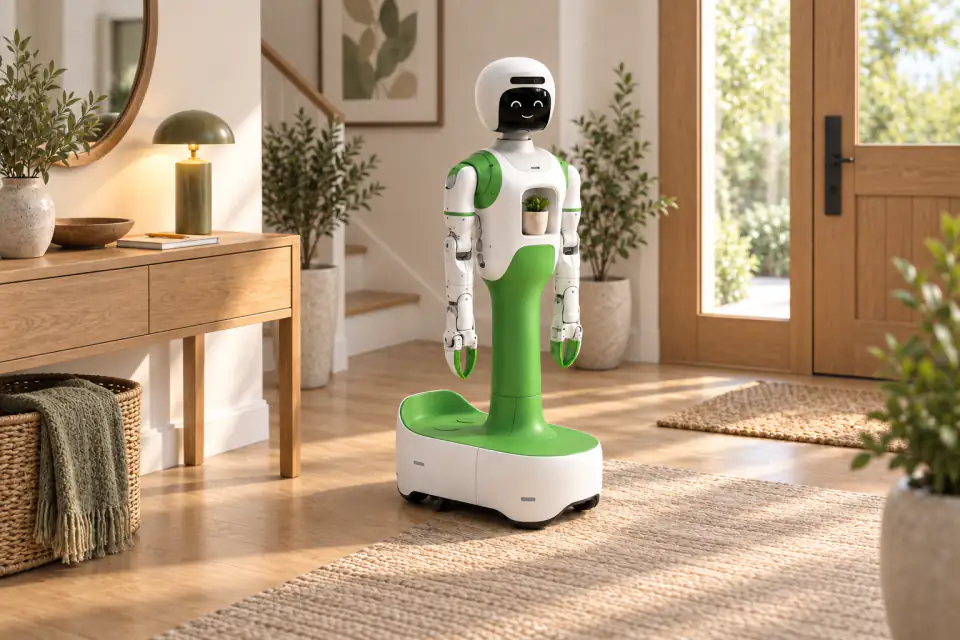
Homebot One presents KOKO as a physical home robot being developed in Fremont, California. The company’s official public pages describe development, in-home testing, and several contexts for exploring the platform. Those pages are the starting point for current identity and status questions; search snippets, reposted videos, and third-party summaries can become outdated or mix KOKO with unrelated products.
The official spelling is K-O-K-O. People may search for Coco robot, robot Coco, Homebot, or similar phrases, but Coco is not presented by Homebot One as the official alternate product name. Older material may use MyMemo One, which Homebot One identifies as an earlier name in the project’s history.
Use the official source that matches the question
Homebot One’s main site provides the company overview, KOKO positioning, development context, press information, and contact path. The KOKO Home page presents the household-oriented vision and waitlist. Separate Care, Research, and Developer pages provide entry points for those contexts. A label on one page should not be assumed to define the hardware, terms, or functions of another program.
Check the page date and ask Homebot One when a detail is not published. A current official answer should take priority over an older article for availability, access, support, pricing, and demonstrated capability. Save the URL and date with any decision record so another person can distinguish sourced facts from your interpretation.
- Company and current KOKO overview: homebotone.com.
- Household vision and waitlist: koko.homebotone.com.
- Care context: care.homebotone.com.
- Research and developer contexts: research.homebotone.com and developer.homebotone.com.
Read the public status without turning it into a purchase promise
The public pages reviewed for this fact sheet describe KOKO in development and invite people to follow updates, join a waitlist, request a demo, or explore a relevant program. A waitlist, contact form, press mention, or demonstration is not by itself an order, confirmed delivery date, retail offer, or guarantee of access. Ask which path is currently open for your location and intended use.
Likewise, a concept scene or roadmap statement is not proof that every depicted behavior is available. Ask the team to separate current demonstrated behavior, work being evaluated, and longer-term direction. Record the build, date, environment, dependencies, supervision, and recovery involved in any result you rely on.
Keep form, function, and program claims separate
Home robot, mobile robot, humanoid, and service robot are not interchangeable promises. A form-related term does not establish intelligence, autonomy, dexterity, stair use, accessibility, safety, or suitability for a task. Use Homebot One’s current description for the version and program being discussed, and ask for a formal classification only when the decision requires one.
The same discipline applies to materials, charging, connectivity, sensors, home maps, privacy, integrations, medical use, and care outcomes. Do not fill an unpublished specification with details from another robot or a generic industry description. Convert each unknown into a direct question and keep it unresolved until current documentation or a controlled demonstration answers it.
- What exact KOKO build and program is being discussed?
- Which bounded task can be demonstrated now, and with how much human help?
- Which route, data, connectivity, setup, and support conditions apply?
- Which statements are current facts, evaluation findings, future directions, or still unknown?
Use a ten-question verification card
Before a demo, pilot, research project, development effort, or purchase conversation, prepare a one-page card. Ask about identity and version, access in your region, current task evidence, environmental limits, human supervision, stop and recovery, data practices, connectivity, support, and complete cost. Request current written material when an answer affects the decision.
Review the card after the conversation and date every answer. Mark observed, stated by Homebot One, sourced elsewhere, and unknown. Confirm changing details again before committing money, data, participants, or household changes. The fact sheet is useful when it makes uncertainty visible and sends the reader back to the responsible current source.
Frequently asked questions
Who makes the KOKO robot?
Homebot One presents and develops KOKO. The official company site is homebotone.com, with program information on Homebot One subdomains.
Is the robot named KOKO or Coco?
The official name used by Homebot One is KOKO. Coco is a common search variation and should not be treated as an official alternate name.
Can I buy KOKO now?
Check current Homebot One information for your location and intended use. Public invitations to join a waitlist or request a demo do not by themselves establish a retail offer, price, or delivery date.
Where should I verify a claim about KOKO?
Start with the relevant official Homebot One page, check its date and scope, and ask the company directly when the current answer is not published. Record the build, program, and evidence behind capability claims.
Sources & further reading
From Homebot One, the team building KOKO in Fremont, California.