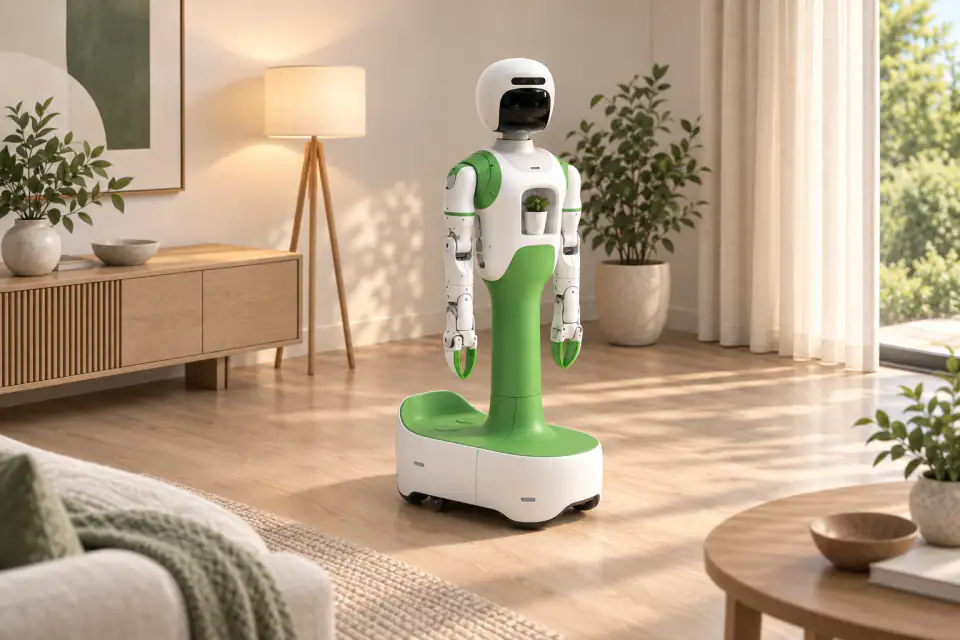
Which Homebot One KOKO is right for your project?
The KOKO lineup introduces four audiences: households, independent-living and care settings, research teams, and developers. Homebot One is still working through development, in-home testing, and engineering validation. The lineup is a way to explore intended uses and partnerships, rather than a statement that four finished products are available to buy.
Begin with the context in which you want to explore a robot. A household evaluating daily interaction has different questions from a laboratory designing a study or a developer planning an application. The relevant product page provides a starting point for that conversation.
KOKO Home: everyday household interaction
KOKO Home describes a vision that combines family interaction, household routines, spatial memory, and small physical actions. Its official page also discusses connected-home coordination. These are company-described areas of development, not a guarantee that every illustrated activity is available in the current build.
For a household demo, choose one activity and explain what would make it useful. Ask about setup, assistance, supported conditions, and the controls available to family members. A focused example will reveal more than a general request to see everything the robot might eventually do.
KOKO Care: presence with personal control
KOKO Care explores conversation, reminders, familiar media, and communication with family in independent-living contexts. The official page explicitly identifies development and in-home testing, with features introduced progressively. It also states that KOKO Care is not a medical device and does not replace professional care or emergency services.
Include the person who would share their home with the robot in any evaluation. Ask which interactions they want, when they prefer quiet, and how they would pause or decline an activity. Begin with preferences and consent, then discuss whether the current system can support that experience.
KOKO Research: questions that need a physical platform
KOKO Research identifies human–robot interaction, perception, spatial and object memory, navigation, and manipulation among its research interests. The platform remains in active development and validation; its capabilities and interfaces are preliminary, and tooling is expected to develop with research partners.
A useful research inquiry states the study question, the behaviors to observe, and the data needed for analysis. Ask which interfaces, logging options, and repeatable procedures are available now. Treat proposed integrations as discussion points until the team confirms their scope and access.
KOKO Developer: ideas for future applications
KOKO Developer outlines household workflows, connected-home integrations, interaction behaviors, telepresence, and education as possible application areas. The published SDK and API examples are illustrative. Interfaces and access are still developing, so those examples should not be treated as a released software contract.
Describe a small application idea, the robot actions it needs, and the external services it would contact. Then ask what can be tested with current tooling and which elements depend on future access. This creates a concrete technical discussion without assuming that a preview already supports production deployment.
Frequently asked questions
Are the four KOKO options shipping products?
The official pages describe development, testing, and prospective access. Consult the team for current availability; these descriptions do not establish shipping dates or purchase terms.
Which KOKO page should I start with?
Choose Home for household experiences, Care for independent-living contexts, Research for studies, or Developer for application ideas. Explain your intended use when contacting the team.
Sources & further reading
From Homebot One, the team building KOKO in Fremont, California.