The dated answer: KOKO is not publicly specified as an ABS robot
As of September 30, 2026, the official Homebot One, KOKO Home, and KOKO Developer pages reviewed for this guide do not identify KOKO as an “ABS robot” and do not publish an ABS resin or enclosure specification. That makes the material claim unknown from public official sources, not confirmed and not disproved.
The phrase can also be ambiguous. ABS may refer to acrylonitrile-butadiene-styrene plastic, initials used as an alleged name, or an incomplete search query. Define the intended meaning before asking whether it applies to KOKO.
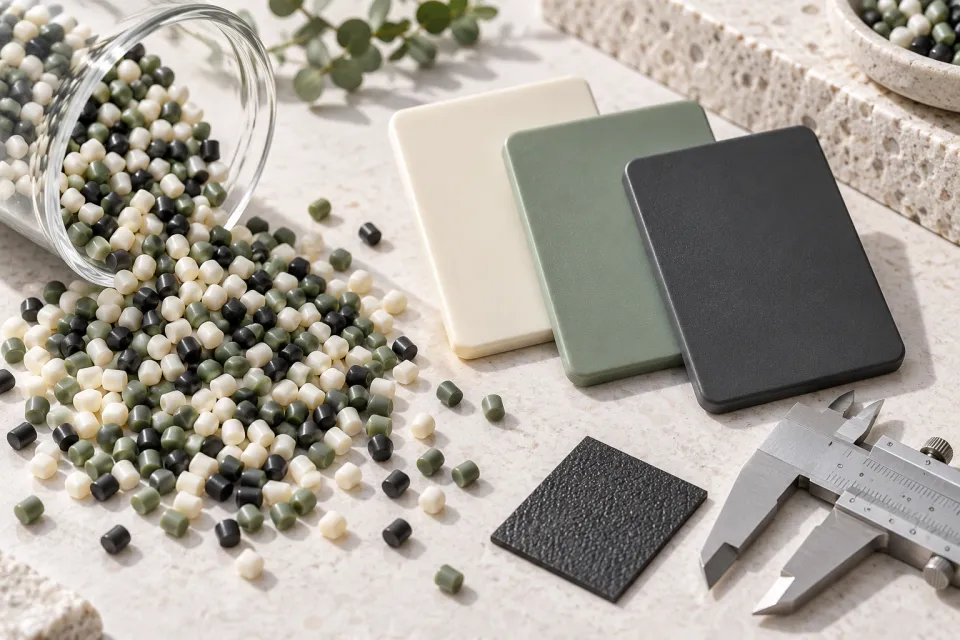
If ABS means plastic, a family name is only the beginning
ASTM D4673-23 covers acrylonitrile-butadiene-styrene plastics and alloys for molding and extrusion. It distinguishes groups, classes, grades, reinforced versions, and tested properties. A statement that a part uses ABS still needs an exact grade, supplier, additives, thickness, process, and intended environment.
For a robot, the answer should also identify the component. A cosmetic panel, structural element, wheel cover, internal bracket, and sensor window can use different materials. One documented ABS part would not make the entire machine an “ABS robot.”
Photos and renderings cannot establish polymer composition
Color, gloss, texture, seams, and apparent stiffness can suggest how an enclosure was designed, but they cannot identify its chemistry or grade. Painted metal, composites, polycarbonate blends, and multiple polymers may look similar in a photograph. Concept art is even less suitable for material identification.
A useful source would be a current product specification, manufacturer material declaration, supplier data tied to a part number, repair manual, certification file, or direct written response from Homebot One. Record the hardware revision because prototype and production materials can change.
Material safety requires specific tests and a complete system view
Do not infer fire performance from the word ABS. UL 94 tests polymeric specimens under controlled conditions and describes the result as a preliminary indication for an application. It does not by itself evaluate complete fire resistance, smoke, heat release, or every finished-product configuration.
A home robot assessment also considers movement, electrical and charging systems, batteries, temperatures, access to parts, human interaction, software behavior, wireless functions, and maintenance. A resin name cannot substitute for finished-product safety evidence.
Ask Homebot One a part-specific question
If material information matters, identify why: cleaning compatibility, impact exposure, allergy or chemical policy, recycling, repair, research documentation, or fire-safety review. Then ask which material and grade are used in the relevant part of the current KOKO build and what tests or declarations are available.
Until a public specification appears, the accurate article wording is: “Homebot One has not publicly specified KOKO as using ABS in the pages reviewed.” Avoid schema fields, captions, image alt text, or FAQs that silently convert the unknown into a product attribute.
Frequently asked questions
Is KOKO made of ABS plastic?
Homebot One’s public pages reviewed on September 30, 2026 do not state that KOKO uses ABS. Request current, part-specific material information from the company.
Does ABS describe a whole robot?
Usually it describes a material used for one or more parts. A robot can combine many polymers, metals, elastomers, coatings, glass, and electronic assemblies.
Can I identify ABS from a KOKO photo?
No. Appearance cannot reliably establish polymer chemistry, grade, additives, or test performance.
Would an ABS material claim prove KOKO is safe?
No. Safety depends on the exact material and part design plus the robot’s complete mechanical, electrical, battery, software, and operating-system evaluation.
Sources & further reading
From Homebot One, the team building KOKO in Fremont, California.