ABS names a material family, not a finished-robot performance level
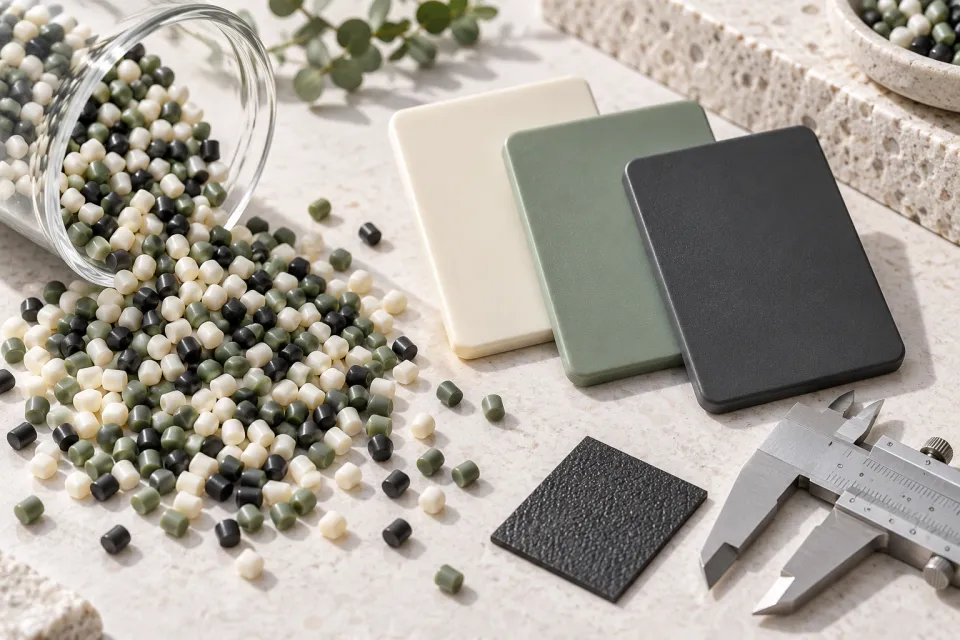
ABS is short for acrylonitrile-butadiene-styrene. ASTM D4673-23 classifies ABS plastics and alloys used for molding and extrusion, including different groups, classes, grades, reinforced versions, and property tests. A product page that says only “ABS” leaves many engineering questions unanswered.
The finished part’s performance depends on the selected grade, additives, colorants, fillers, geometry, wall thickness, manufacturing quality, assembly, environment, and expected loads. The same family name can appear in products with very different requirements and results.
Ask for properties tied to the actual part
A useful material disclosure identifies the resin grade and the enclosure or component where it is used. It should connect supplier data and test conditions to the part’s expected temperature, impact, cleaning, sunlight, chemical, wear, and service environment. Generic adjectives such as durable, premium, or rugged are not substitutes for that record.
ASTM’s classification includes properties such as tensile behavior, modulus, impact, softening point, and heat-deflection behavior for relevant grades. Those material tests help describe specimens; they do not by themselves certify a robot enclosure, joint, or complete system.
- Exact resin and supplier grade, including recycled content or blends where relevant.
- Additives, reinforcement, coating, color, and minimum part thickness.
- Test method, specimen conditioning, temperature, orientation, and reported result.
- Finished-part validation for drops, impacts, fasteners, heat, cleaning, aging, and service.
Do not infer fire safety from the word ABS
UL 94 evaluates how polymeric material specimens respond to specified ignition conditions in controlled tests. UL describes those results as a preliminary indication for a particular application and notes that the standard does not evaluate complete fire resistance, smoke, heat release, or every end-use configuration.
A flammability classification also depends on details such as material grade and specimen thickness. Ask for the exact rating at the thickness used, the applicable end-product standard, and evidence for the finished construction. “ABS” alone does not mean flame resistant, UL certified, or safe near a battery or charger.
Evaluate the whole home robot system
A home robot operates near people and may combine moving parts, batteries, chargers, electronics, wireless radios, software, and AI-enabled behaviors. UL’s consumer and commercial robot guidance points to robot product safety, functional safety, battery and charger evaluation, electromagnetic compatibility, wireless testing, cybersecurity, and interoperability—not just enclosure material.
Material choice is one input to that system review. Ask how the enclosure manages sharp edges, pinches, hot surfaces, impact, access to energized parts, ventilation, cleaning, and service. A strong shell cannot compensate for unsafe movement or an unsuitable charger.
Apply the material question to KOKO carefully
Homebot One’s public pages reviewed on September 30, 2026 do not publish an ABS resin, enclosure, or structural material specification for KOKO. Images and renderings cannot reveal the exact polymer or prove that all visible panels use one material.
If material matters for research, cleaning, accessibility, repair, sustainability, or deployment, ask Homebot One for the current build’s part-specific information. Record the hardware revision and date because development hardware can change. Until then, discuss ABS as a general engineering topic rather than a KOKO fact.
Frequently asked questions
Is ABS a good material for a home robot?
It can be suitable for some parts, but suitability depends on the exact grade, part design, environment, loads, manufacturing, and finished-product tests.
Does ABS mean a robot is impact resistant?
No single result follows from the family name. Ask for the grade, thickness, test method, test result, and finished-part validation.
Is ABS automatically flame retardant?
No. Flammability performance depends on the grade, thickness, test, and end-use construction. A specific rating must be documented.
Is KOKO made from ABS?
The official pages reviewed on September 30, 2026 do not state that KOKO uses ABS. Request current, part-specific material information from Homebot One.
Sources & further reading
From Homebot One, the team building KOKO in Fremont, California.