Where to watch the official film
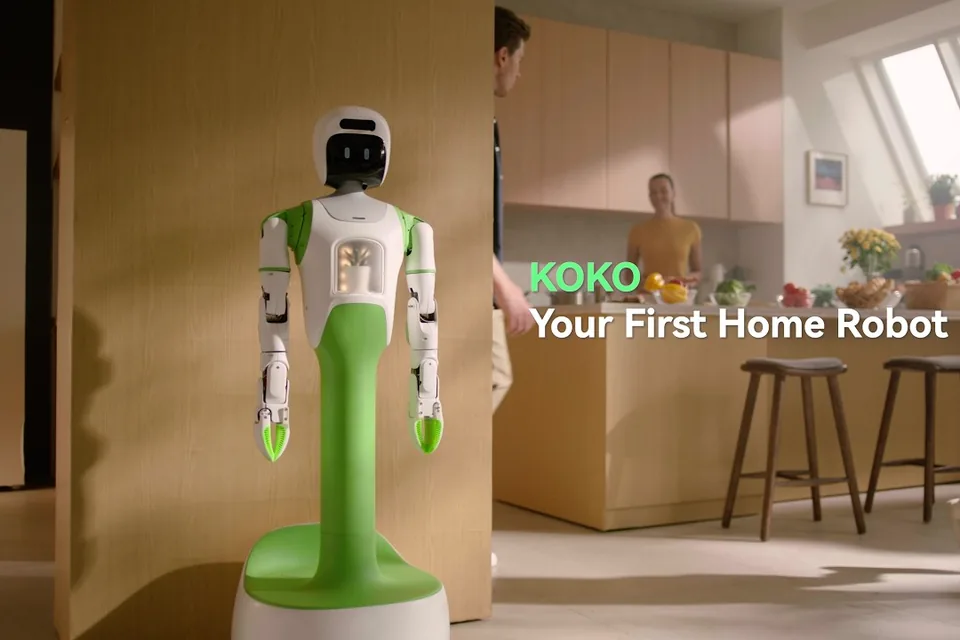
Introducing KOKO by HomeBot ONE is a three-minute film published on the official Homebot One Inc YouTube channel on July 3, 2026. It also plays in the Meet KOKO section near the top of homebotone.com, where the player opens a few seconds in so the film starts on KOKO rather than on a title card.
Watching the film from the official homepage or the HomebotOne YouTube channel is the simplest way to be sure you are seeing the company’s own video and not a re-upload, an edit, or a clip from an unrelated robot with a similar name.
What the “Real footage” label means
On homebotone.com the film carries a Real footage label and the note “Filmed with the real KOKO. Not AI-generated.” That is a specific claim about the pictures: the robot you see on screen is the physical KOKO, not a computer-generated stand-in.
Homebot One Inc makes a related disclosure on its Kickstarter page for the campaign video. There, the company says the narration was produced with an AI text-to-speech tool, a few scene transitions were adjusted with AI editing tools, and all footage of KOKO is real and shows the actual prototype, with AI not used to create or alter what KOKO is shown doing.
What a produced film can and cannot tell you
A brand film is edited to show selected moments at their best. It is good evidence of what the robot looks like, how it moves, and what the team is aiming for, but it is not a hands-on review, a reliability test, or a promise that every scene works the same way in every home.
To get a fuller picture, compare the film with less polished material: the in-home testing clip in the Safe at home section of homebotone.com, which shows KOKO working beside a bed, and third-party coverage such as the rAVe [PUBS] video recorded at CEDIA Expo 2026.
Match what you see to written commitments
When a film shows a capability, look for the same capability in writing. Homebot One Inc describes its safety design on the homepage and Kickstarter page: an omnidirectional wheeled base that slows or stops near people, pets, and obstacles, collision detection, and an emergency stop button.
The privacy design is described in writing too, including a physical Memory Key and the SoftSeal privacy cover. The company also says KOKO is in development and in-home testing and that features are introduced progressively, so treat the film as a picture of the direction, and the written pages as the reference for what is stated today.
Next steps after watching
If the film answers the question “is this a real robot?”, the next questions are about fit and timing. The homepage lets you sign up for launch updates or apply for in-home testing, and the Kickstarter page lets you follow the campaign before it goes live.
Keep notes on which moments in the film matter most to your household, such as reminders, finding items, or family check-ins, and use them as a checklist when you read campaign details or talk to the team.
- Watch on homebotone.com or the HomebotOne YouTube channel
- Compare with the in-home testing clip and press videos
- Check each capability against the written product pages
Frequently asked questions
Is the Introducing KOKO film real footage?
Homebot One Inc labels the homepage film as real footage filmed with the real KOKO and not AI-generated. For its Kickstarter campaign video, the company separately discloses AI narration and some AI-adjusted transitions while stating that all footage of KOKO is real.
How long is the film and when was it published?
It runs about three minutes and was published on the HomebotOne YouTube channel on July 3, 2026.
Does the film show a finished product?
No. Homebot One Inc says KOKO is in development and in-home testing and that features are introduced progressively. Use the written product pages to see what is stated today.
Sources & further reading
From Homebot One Inc, the team building KOKO in Fremont, California.