Why KOKO rolls instead of walking
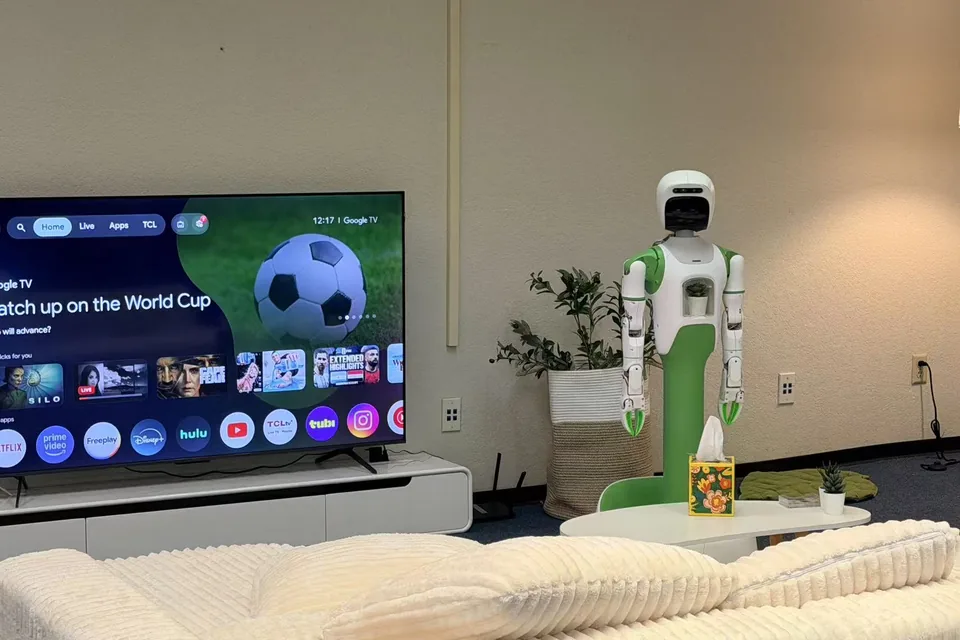
KOKO has two arms and a head, but it moves on a wheeled base rather than legs. Homebot One Inc sums up the choice on its homepage as “Wheels, not legs. Built to be safe around people.”
For a robot that shares a home with older adults, a low wheeled base keeps the weight close to the floor and avoids the balance problems of walking. It also means KOKO is designed for single-level routes, so homes with stairs should plan where it will work.
Movement: an omnidirectional base with a speed limit
Homebot One Inc describes an omnidirectional base with a 1 m/s top speed that slows and stops when people, pets, or obstacles get close. Omnidirectional means the base can move sideways and turn in place, which helps in narrow hallways and around furniture.
One meter per second is roughly a relaxed walking pace. Around people the more important behavior is the slowing and stopping, so a person does not have to step out of the robot’s way.
Stability: 66 pounds on a low, wide base
KOKO weighs 66 lb, and the company says that weight sits on a low, wide wheeled base. The Kickstarter page calls this a low-center-of-gravity, tip-proof design that keeps KOKO steady around the home.
The same pages list collision detection and an emergency stop button. Make sure everyone in the household knows where the button is and what it does before KOKO starts working in shared rooms.
- Omnidirectional wheeled base
- 1 m/s top speed, slows and stops near people
- 66 lb on a low, wide base
- Collision detection and an emergency stop button
Out of the way when it is not needed
Homebot One Inc says KOKO returns to its dock when it is not needed, clear of walkways. Choose a dock spot away from doorways, the path to the bathroom, and places where someone might walk at night.
A consistent home position also makes the robot easier to live with: everyone knows where it will be when it is resting, and nobody has to remember to move it.
Clear limits: what KOKO never does
The homepage states that KOKO never lifts, holds, or transfers a person. Help with standing up, getting into bed, or recovering after a fall stays with people.
Homebot One Inc also says KOKO is not a medical device and does not replace professional care, emergency services, or human judgment. Treat it as help with small tasks and reminders, alongside the people and services a household already relies on.
Frequently asked questions
How fast does KOKO move?
Homebot One Inc lists a 1 m/s top speed and says the base slows and stops when people, pets, or obstacles get close.
How heavy is KOKO?
KOKO weighs 66 lb on a low, wide wheeled base, according to the homepage.
Can KOKO help someone get up after a fall?
No. KOKO never lifts, holds, or transfers a person, and it is not a medical device or an emergency service.
Sources & further reading
From Homebot One Inc, the team building KOKO in Fremont, California.