Start by correcting the entity, not forcing the query
A search for “live TV robot Coco” may be trying to find Homebot One KOKO, but that connection is not automatic. Homebot One spells the product K-O-K-O. “Coco” is a common phonetic spelling and can lead to unrelated products, companies, characters, or videos.
The safest first step is to identify the company, product, and source independently. Look for Homebot One, the KOKO spelling, and a homebotone.com domain. If those identifiers are absent, keep the result separate until a primary source connects it to KOKO.
Break the phrase into four verification questions
The query contains four assumptions: that the subject is a robot, that its name is Coco, that the footage came from television, and that it aired live. Search snippets may repeat all four without proving any of them. Turn each assumption into a question before following more results.
Ask: Who made the device? What exact name does the maker use? Who uploaded the video? Which broadcaster and episode supposedly carried it? This approach narrows the search while protecting you from a confident but recycled caption.
- Try “Homebot One KOKO official” to verify the entity.
- Add the alleged network, program, event, or date only if the clip supplies it.
- Use quotation marks for a distinctive on-screen phrase rather than for an assumed product name.
- Exclude unrelated results only after you know which manufacturer you need.
Distinguish a broadcast from a repost or demo
A vertical clip with a station logo may still be a repost, reaction, advertisement, or screen recording. Cropping can hide the original uploader and sponsor disclosure. A convention presentation can be streamed live without becoming a television broadcast, and a television segment can be recorded rather than live.
Open the full page instead of relying on the preview. Record the uploader, publication date, program title, visible credits, and link to the source. If the clip is only available through a repost, describe it as a repost and keep the original broadcast claim unverified.
Use current KOKO pages to test the match
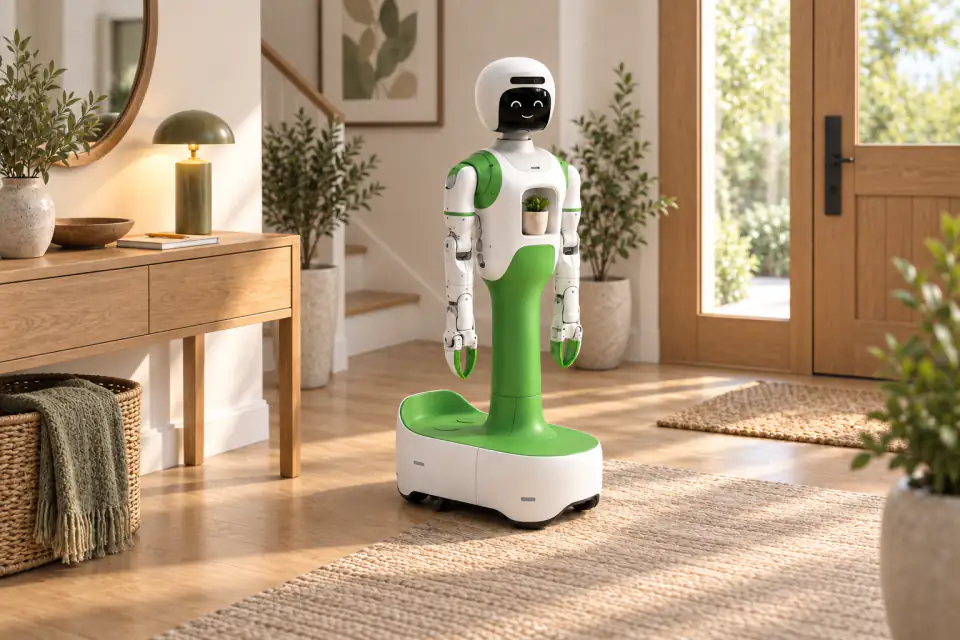
Homebot One’s official pages describe KOKO as a physical home robot being developed in Fremont, California, with in-home testing and engineering validation. The KOKO Home page provides a waitlist and demo request. These facts help identify the project but do not prove that an unknown video shows it.
Do not infer identity from color, shape, wheels, arms, a face display, or a home setting alone. A visual match is a lead. Confirmation requires a source that names both KOKO and Homebot One, ideally attached to the original footage or event.
Write the result without creating a false association
If your search ends without a primary-source match, say so plainly: “We could not verify that the ‘Coco’ clip depicts Homebot One KOKO or came from live television.” This is more useful than choosing the nearest-looking robot and repeating an uncertain title.
Keep television brands out of the headline and artwork unless the article is actually reporting a verified appearance. Homebot One and KOKO have no verified CBS or Paramount affiliation in the sources reviewed for this guide. Use “the price is right” only in its ordinary value sense when discussing cost.
Frequently asked questions
Is the Homebot One robot called Coco?
No. Homebot One uses the official name KOKO. Coco may be a search spelling, but it is not presented as an official alternate name.
Does a TV logo prove a clip is from a broadcast?
No. Reposts, reactions, screen recordings, and advertisements can preserve or add logos. Verify the clip through the broadcaster’s own episode or press page.
How do I search for the right KOKO robot?
Use the product name KOKO, the company Homebot One, and the official domain homebotone.com together.
Was KOKO on The Price Is Right?
The official sources reviewed on September 30, 2026 did not verify a KOKO appearance or affiliation with the CBS program.
Sources & further reading
From Homebot One, the team building KOKO in Fremont, California.