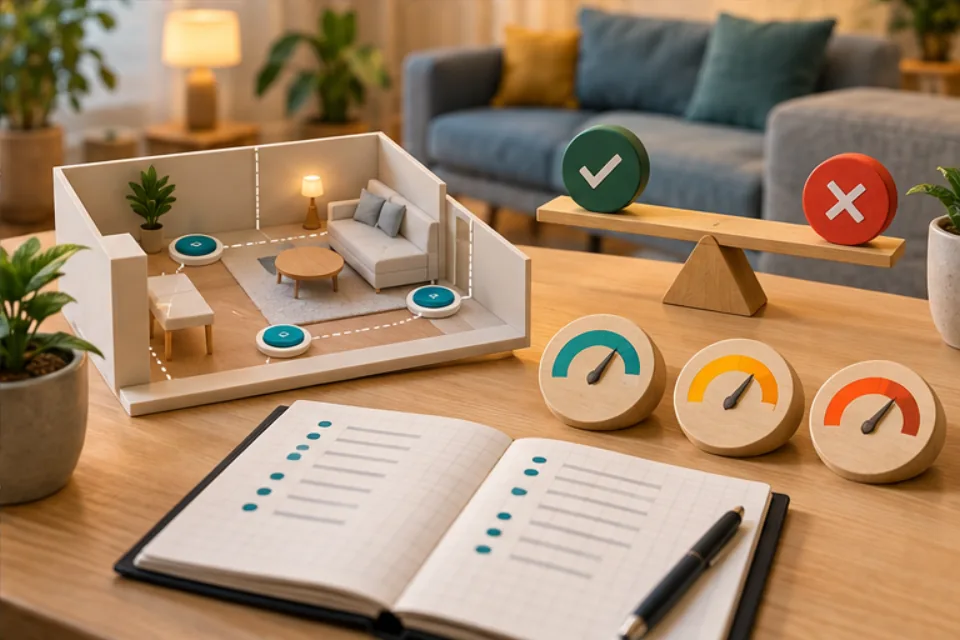
Use three stages to answer three different questions
Homebot One invites demo requests, but the public overview reviewed on October 2, 2026 did not define standard proof-of-concept or pilot programs. This guide uses those stages to organize a decision. Ask which evaluation arrangement is available and what its written scope calls it before allocating time or money. The availability of one stage does not establish access to the next.
A proof of concept asks whether a narrow technical or interaction idea appears feasible under controlled conditions. A pilot asks whether a defined workflow performs usefully in a representative setting over a bounded period. A purchase or longer deployment asks whether the complete, supported arrangement is ready for continuing use and justified by its total obligation. Skipping the question definition makes every stage look more successful than its evidence supports.
- Proof of concept: can one specific idea work under stated conditions?
- Pilot: does a defined workflow remain useful in the intended environment?
- Purchase: are performance, support, cost, responsibilities, and lifecycle terms acceptable?
Keep a proof of concept narrow and inexpensive
Choose one uncertain assumption that can be observed: an interface path, a controlled movement route, an integration exchange, or an interaction pattern. Specify the configuration, environment, operator help, starting state, success threshold, and stop condition. A successful proof of concept supports only that defined feasibility question. It does not establish household reliability, broad autonomy, safety in every room, production readiness, or a retail price.
Budget the work needed to create and observe the test: access, engineering, configuration, sample data, room preparation, staff time, documentation, and cleanup. Use a fixed end date and prohibit scope expansion without a new decision. If the test cannot answer the question, record why. An inconclusive result can still be valuable when it reveals a missing interface, requirement, measurement, or dependency before a more expensive pilot.
- Single feasibility question and explicit non-goals
- Known test conditions and allowed human assistance
- Evidence to collect and threshold for advancing
- Time, spending, and change boundaries
Design a pilot around real-setting variation
A pilot should test a small number of useful routines in conditions that resemble the intended setting. Define rooms, surfaces, people, times, network conditions, interruptions, supervision, privacy rules, and recovery paths. Repeat the routine enough to observe variation rather than celebrating a single polished run. Track completed attempts, partial completions, interventions, time, user feedback, incidents, downtime, and support contacts.
NIST's AI Risk Management Framework offers a voluntary structure organized around Govern, Map, Measure, and Manage. A KOKO evaluation can borrow that discipline: assign owners and rules, map the people and context, measure agreed outcomes and risks, and manage findings through changes or stop decisions. The framework does not certify KOKO and should not be used as proof of a feature that Homebot One has not documented.
- Representative users and environment with informed participation
- Routine-level success, assistance, reliability, and recovery measures
- Privacy, safety, security, accessibility, and incident controls
- Human backup and stop conditions
- Decision rule for expansion, redesign, waiting, or ending
Require a stronger baseline before purchase
A continuing commitment needs more than a positive pilot average. Reconcile the evaluated hardware, software, accessories, settings, support, and environment with the offered configuration. Ask about delivery, setup, training, updates, repair, security notices, data handling, change control, warranty or service terms, recurring charges, and end-of-use. A roadmap idea should remain outside the present value calculation until it is part of the written deliverable.
Federal acquisition guidance on first-article testing illustrates a useful principle: testing is meant to determine whether a product conforms to stated requirements, and decision makers should consider cost, schedule, and alternatives to the test. That guidance governs federal contracting, not a household KOKO transaction. Use it as planning inspiration: write requirements before testing and make the cost of added evidence proportional to the risk of a wrong decision.
- Configuration evaluated and configuration offered
- Requirements demonstrated, documented, and contractually included
- Complete acquisition, operation, support, and exit cost
- Named owner for acceptance and continuing oversight
Move through explicit decision gates
Create a one-page gate record after each stage. List the question, configuration, conditions, evidence, failures, unresolved risks, actual cost, and recommendation. Decide whether to advance, repeat with a specific change, reduce scope, seek more information, or stop. Following GAO's advice to update estimates with actual costs, replace the stage's initial budget with what was spent before sizing the next commitment.
The price is right for a proof of concept when a narrow test removes enough uncertainty to justify its cost. A pilot must earn its larger time commitment with evidence from representative use. A purchase requires a stronger case again: useful results, a matched written deliverable, affordable continuing obligations, and workable support. Use that progression to choose the next step, rather than letting an encouraging demonstration become an automatic purchase decision.
- Advance only on evidence defined before the stage
- Carry open risks forward with owners and deadlines
- Replace estimates with actuals and recheck the total
- Keep future features outside the current decision
Frequently asked questions
Does Homebot One offer an official KOKO proof-of-concept program?
The official pages reviewed on October 2, 2026 did not publish a standard program with that name. Use proof of concept as a planning category and ask Homebot One what current access and evaluation arrangements are available.
What is the main difference between a KOKO proof of concept and pilot?
A proof of concept tests one narrow feasibility assumption under controlled conditions. A pilot evaluates defined routines, people, controls, and support in a more representative setting over a bounded period.
Does a successful KOKO demo justify a purchase?
A demo is evidence for what was observed in its conditions. A purchase decision also needs a matched configuration, repeatable value evidence, complete cost, support, privacy, security, acceptance, and lifecycle terms in writing.
Are KOKO, Coco, and Co Co different pilot versions?
Homebot One identifies the product as KOKO. If you searched for Coco or Co Co, verify that the result refers to Homebot One; those spellings alone establish neither a product version nor an evaluation program.
Sources & further reading
- Homebot One: Official KOKO overview, testing status, and demo request (opens in a new tab)
- NIST: AI Risk Management Framework (opens in a new tab)
- U.S. GAO: Cost Estimating and Assessment Guide (opens in a new tab)
- Federal Acquisition Regulation Subpart 9.3: First Article Testing and Approval (opens in a new tab)
From Homebot One, the team building KOKO in Fremont, California.